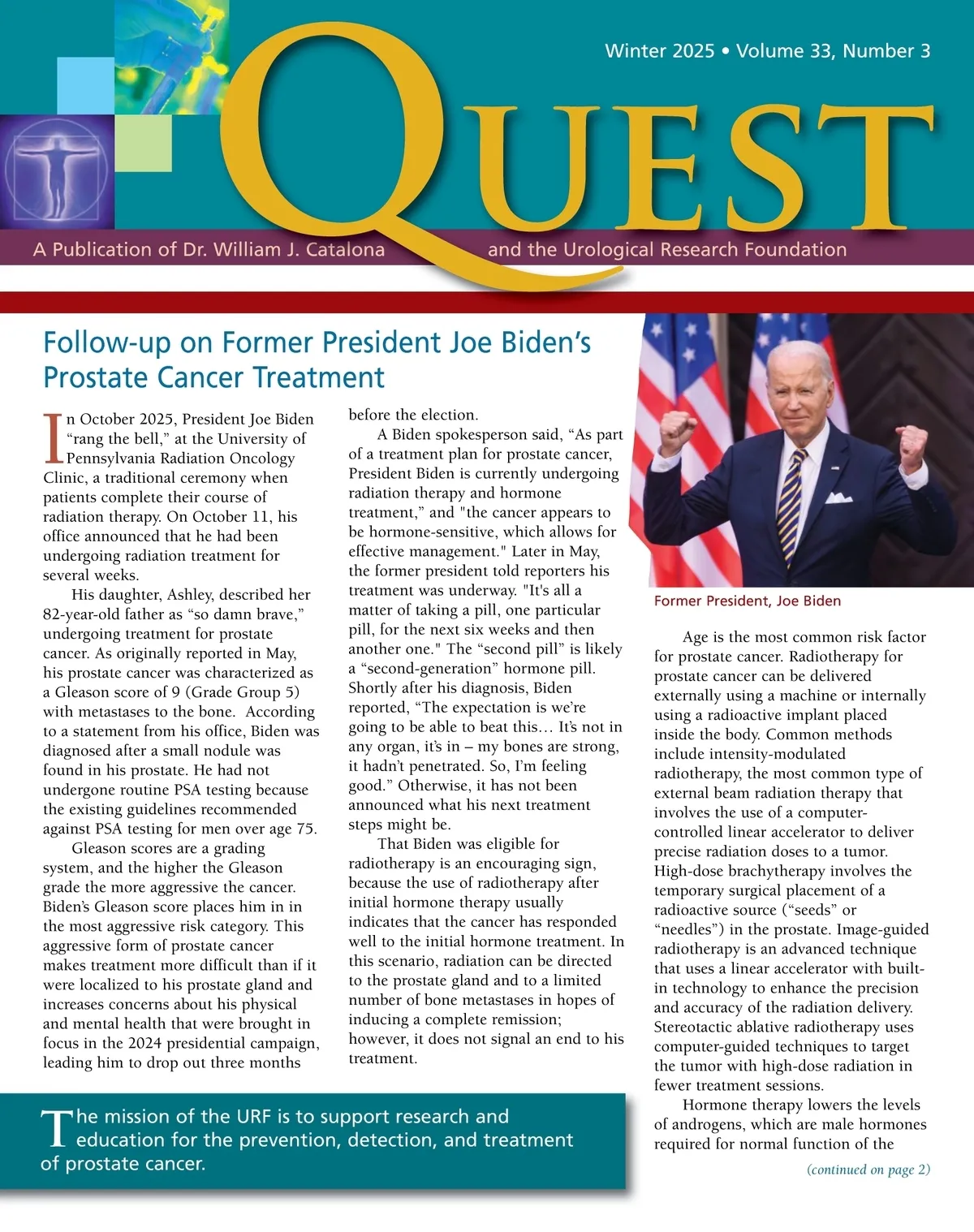
A Publication of Dr. William J. Catalona Q uest Winter 2025 • Volume 33, Number 3 and the Urological Research Foundation before the election. A Biden spokesperson said, “As part of a treatment plan for prostate cancer, President Biden is currently undergoing radiation therapy and hormone treatment,” and "the cancer appears to be hormone-sensitive, which allows for effective management." Later in May, the former president told reporters his treatment was underway. "It's all a matter of taking a pill, one particular pill, for the next six weeks and then another one." The “second pill” is likely a “second-generation” hormone pill. Shortly after his diagnosis, Biden reported, “The expectation is we’re going to be able to beat this… It’s not in any organ, it’s in – my bones are strong, it hadn’t penetrated. So, I’m feeling good.” Otherwise, it has not been announced what his next treatment steps might be. That Biden was eligible for radiotherapy is an encouraging sign, because the use of radiotherapy after initial hormone therapy usually indicates that the cancer has responded well to the initial hormone treatment. In this scenario, radiation can be directed to the prostate gland and to a limited number of bone metastases in hopes of inducing a complete remission; however, it does not signal an end to his treatment. Former President, Joe Biden Follow-up on Former President Joe Biden’s Prostate Cancer Treatment I n October 2025, President Joe Biden “rang the bell,” at the University of Pennsylvania Radiation Oncology Clinic, a traditional ceremony when patients complete their course of radiation therapy. On October 11, his office announced that he had been undergoing radiation treatment for several weeks. His daughter, Ashley, described her 82-year-old father as “so damn brave,” undergoing treatment for prostate cancer. As originally reported in May, his prostate cancer was characterized as a Gleason score of 9 (Grade Group 5) with metastases to the bone. According to a statement from his office, Biden was diagnosed after a small nodule was found in his prostate. He had not undergone routine PSA testing because the existing guidelines recommended against PSA testing for men over age 75. Gleason scores are a grading system, and the higher the Gleason grade the more aggressive the cancer. Biden’s Gleason score places him in in the most aggressive risk category. This aggressive form of prostate cancer makes treatment more difficult than if it were localized to his prostate gland and increases concerns about his physical and mental health that were brought in focus in the 2024 presidential campaign, leading him to drop out three months T he mission of the URF is to support research and education for the prevention, detection, and treatment of prostate cancer. Age is the most common risk factor for prostate cancer. Radiotherapy for prostate cancer can be delivered externally using a machine or internally using a radioactive implant placed inside the body. Common methods include intensity-modulated radiotherapy, the most common type of external beam radiation therapy that involves the use of a computer-controlled linear accelerator to deliver precise radiation doses to a tumor. High-dose brachytherapy involves the temporary surgical placement of a radioactive source (“seeds” or “needles”) in the prostate. Image-guided radiotherapy is an advanced technique that uses a linear accelerator with built-in technology to enhance the precision and accuracy of the radiation delivery. Stereotactic ablative radiotherapy uses computer-guided techniques to target the tumor with high-dose radiation in fewer treatment sessions. Hormone therapy lowers the levels of androgens, which are male hormones required for normal function of the (continued on page 2)
Quest Winter 2025: Page 1